
What Is an Apostille, and Do You Actually Need One?
If you are moving abroad, marrying overseas, or sending an important document to another country, someone has probably told you that you need an apostille. Most people have never heard the word before that moment, and the explanations online tend to raise more questions than they answer.
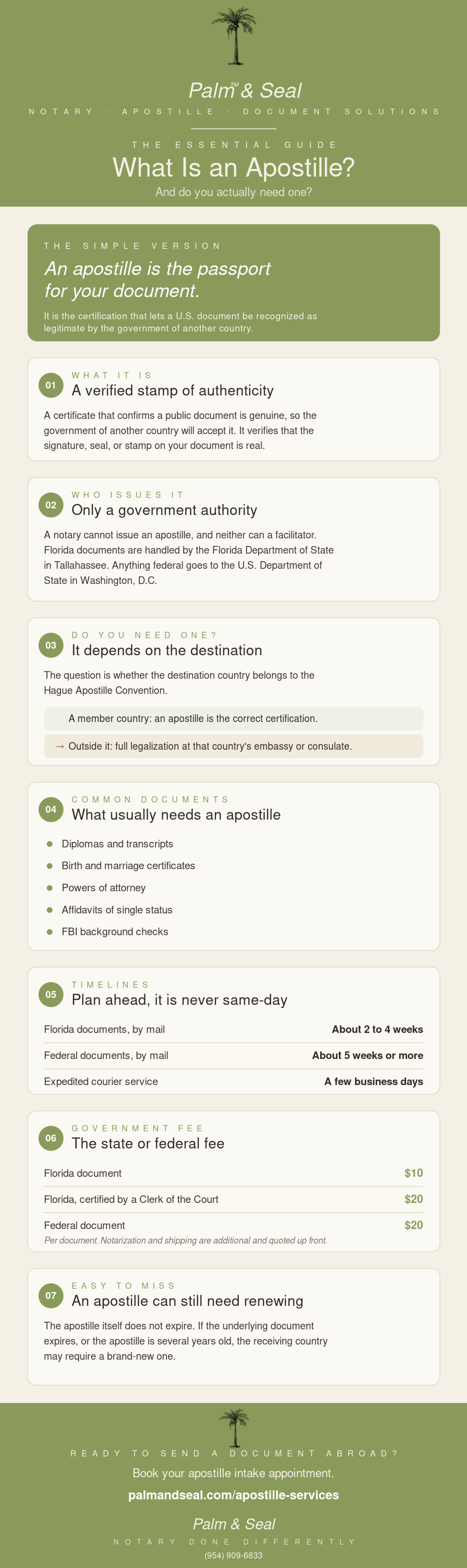
Here is the simplest way I describe it to my clients: an apostille is the passport for your document. It is the certification that allows a document issued in the United States to be recognized as legitimate by the government of another country. I handle apostilles for documents from all fifty states and federal agencies, for clients across the country and around the world, so wherever your document was issued, you are in the right place.
Below I will walk you through what an apostille actually is, how to tell whether you need one, and what the process really looks like from start to finish.
What Is an Apostille?
An apostille is a certificate that verifies the authenticity of a public document so it can be accepted in another country. It confirms that the signature, seal, or stamp on your document is genuine.
An apostille does not come from me, and no notary can issue one either. Only a designated government authority can. Every state authenticates its own documents through its Secretary of State or an equivalent office, and federal documents are handled by the U.S. Department of State in Washington, D.C. Wherever in the country your document originates, I coordinate directly with the office that has authority over it.
This is the first thing people misunderstand. A notary public cannot issue an apostille, and neither can a facilitator like me, even though preparing documents for apostille is exactly what I do. My role is to prepare your document correctly, confirm it meets every requirement, and coordinate the entire process with the issuing authority on your behalf.
Do You Actually Need One?
Not every document headed overseas needs an apostille. Whether you need one comes down to a single question: is the destination country a member of the Hague Apostille Convention?
When the country is a member, an apostille is the correct certification, and that is the route we take.
If the country is not a member, an apostille will not be accepted. Those documents go through full legalization directly with the country's embassy or consulate, which is a longer, multi-step process.
Before I begin any apostille, I confirm where the document is going and check the destination country's status. I also guide you to ask the receiving agency a few specific questions up front, because the office receiving your document sometimes has its own conditions. Confirming those details early is how documents get accepted the first time.
Which Documents Commonly Need an Apostille?
I have apostilled documents for clients across a wide range of situations. The most common include:
Diplomas and transcripts for people taking jobs or continuing their education abroad.
Birth and marriage certificates for expats updating their records or marrying overseas.
Powers of attorney for handling property or family matters in another country.
Affidavits of single status for those marrying a foreign citizen.
FBI background checks for residency and work-visa applications abroad.
Financial and medical records for business or healthcare matters in another country.
Each document type carries its own requirements, and that is where the details matter.
The Requirements That Trip People Up
A document cannot be apostilled simply because you have a copy of it. Each type has specific conditions that must be met first, and missing one is the most common reason a document gets delayed.
A few examples from my own work:
Diplomas and transcripts. I recently apostilled a university diploma and transcripts for a client relocating to Colombia for a government job. These were certified digital copies bearing the registrar's signature. I performed the copy certification myself, printing them from the electronic record under the proper notarial certificate, then sent them to the state. No additional notarization was needed beyond my own.
Birth certificates. A certified long-form birth certificate is required, and a standard photocopy will not work. I once helped a father in the United Kingdom whose daughter had been born in the United States. He appointed me through a limited power of attorney to request and receive the certificate, after which I sent it to the issuing state for the apostille and overnighted it to him overseas.
FBI background checks. These are federal documents, so they are apostilled by the U.S. Department of State rather than a state office. Standard turnaround there currently runs about five weeks or more, though I work with couriers who can typically bring that down to about two weeks.
How Long Does an Apostille Take?
Timing is the single biggest misconception I encounter. Because the apostille is issued by a government office, it is never same-day.
State-level apostilles generally take a few weeks by mail once shipping in both directions is included, though the exact timeline varies from state to state. In Florida, where I am based, standard processing currently runs about two to four weeks. Federal documents through the U.S. Department of State are taking longer right now, generally five weeks or more. When a client is on a deadline, I use trusted couriers who hand-deliver documents and return them by overnight shipping, which brings these timelines down significantly. Expedited service costs more, since my own costs rise with courier fees and overnight shipping, and I am always clear about that before we begin.
What Does an Apostille Cost?
There is no single sticker price for an apostille, because no two requests are the same. What you pay depends on a few things: the type of document, whether it needs to be notarized first (in person or by remote online notarization), how many documents you are sending, and how quickly you need it back.
Every quote I give is all-inclusive. Government filing fees, my preparation and certification work, coordination with the issuing authority, and tracked shipping within the U.S. are built into one flat price, so the number you see is the number you pay. International shipping, when you need it, is the only item quoted separately, and I confirm that up front.
You will always have the full price in writing before any work begins.
Can You Handle an Apostille Yourself?
Some people can. If you have one straightforward document and plenty of time to mail it in and track it yourself, you may not need help.
Here is where people tend to get burned. Different documents have different requirements, and each state charges its own rates and follows its own process depending on the document and the destination country. A small mistake, like the wrong version of a birth certificate or a skipped prerequisite, means starting over and losing weeks. When you are coordinating a move or a wedding abroad on a firm deadline, that lost time is expensive.
My service covers all fifty states and federal documents. Every document gets reviewed and confirmed against requirements before anything is submitted. From there I coordinate the notarization, the shipping, the couriers, and the return delivery, using trackable shipping at every step and sending regular updates along the way. My clients never have to wonder where their document is in the process. They simply look forward to receiving it, finished and apostilled.
As a Certified Apostille Services Facilitator™, I have never had a document I prepared be rejected. That record comes from checking the requirements carefully every single time.
A Real Example
A woman in New Jersey called me because her sister in Miami needed to sign a power of attorney urgently. Their parent had passed away in Albania, and she needed the document apostilled quickly to handle arrangements there. Her plan was to fly to Florida, sign with me, then drive to Tallahassee herself to walk the document in.
She did not need to do any of that. I explained that I could handle the whole thing without her flying down or making the long drive. Because her sister did not have a valid ID, the notarization was completed using a credible witness. The finished, apostilled document reached her within five business days, during a week when the last thing she needed was one more thing to manage.
One Thing Most People Get Wrong: Apostilles and Expiration
An apostille itself does not expire. The document underneath it can, though, and this catches people off guard. If the underlying document expires, or if the apostille is more than a certain number of years old, the country you are living in or moving to may require a brand-new apostille. At that point, the process begins again.
Think of it the way you think about your passport. The apostille is the passport for your document, and like a passport, it sometimes has to be renewed before another country will honor it.
Who I Help
Most of my clients fall into a few groups:
People relocating overseas, who often need five to ten separate documents apostilled at the state or federal level.
Expats already living abroad who need new or updated documents, frequently because they are getting married, renewing residency, or transacting business.
Students heading to school in another country.
Couples planning a destination wedding.
Buyers purchasing property abroad who need mortgage and closing paperwork executed and apostilled.
Cruise line and other travel workers who need to send documents home so family members can transact business on their behalf.
If you see yourself in any of these, you are exactly who I built this service for.
Ready to Start?
If you need a document apostilled, the next step is simple. Book your apostille request intake appointment at palmandseal.com/apostille-services, and I will guide you from there.
You should not have to become an expert in international document authentication to get your paperwork accepted abroad. That is my job, and I take care of it from start to finish so you can focus on the new chapter waiting on the other side.
Frequently Asked Questions
Is an apostille the same as notarization?
No. Notarization verifies a signature on a document. An apostille certifies that the document, including any notarization on it, is authentic so a foreign government will accept it. Many documents need to be notarized first and then apostilled.
Does an apostille expire?
The apostille itself does not expire. If the underlying document expires or the apostille becomes several years old, the receiving country may still require a new one.
Can I get an apostille the same day?
No. Apostilles are issued by a government office, so same-day issuance is not possible. Expedited courier handling can bring state documents down to a few business days and federal documents to roughly two weeks.
What if the country I'm sending my document to isn't in the Hague Convention?
That document needs full legalization through the country's embassy or consulate instead of an apostille. I can explain which path applies to your situation.
How much does an apostille cost?
It depends on the document, how many you are sending, whether notarization is needed, and how quickly you need it back. Every quote is all-inclusive: government filing fees, my work, and tracked U.S. shipping are built into one flat price you approve before I start. International shipping is the only possible add-on, and I confirm it up front.
Blog articles are for educational and informational purposes only. Palm & Seal is not a law firm and does not provide legal advice. Always consult a licensed professional regarding your individual situation.